
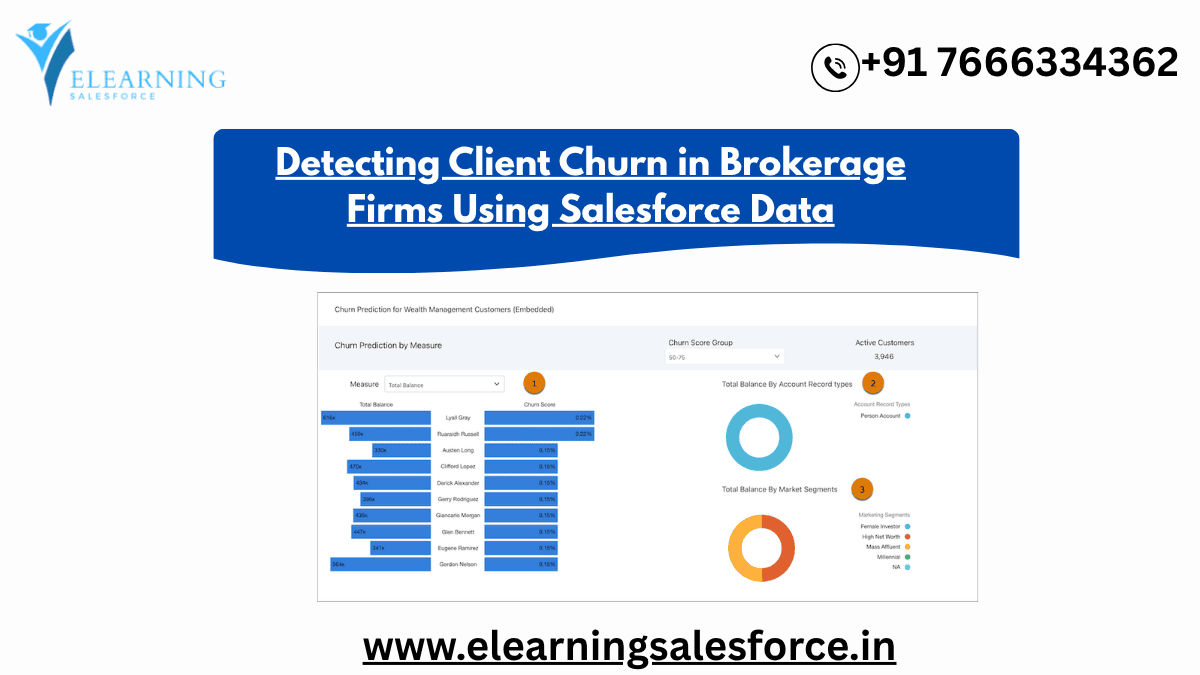
In today’s highly competitive financial market, client loyalty is both invaluable and fragile. Brokerage firms face a growing challenge — retaining clients who have more choices, more access to information, and higher service expectations than ever before. When a long-time client suddenly shifts assets to another firm or stops engaging with their advisor, it’s often too late to intervene. This is where detecting client churn with Salesforce becomes a powerful strategy, turning data into actionable insights that help firms identify early signs of attrition and take preventive action before clients walk away.
Salesforce, known globally for transforming customer relationship management, is now a critical tool in the financial services industry. Through its AI-driven analytics, automated workflows, and predictive intelligence, brokerage firms can use Salesforce data to pinpoint behavioral patterns that signal client dissatisfaction or disengagement. Detecting client churn with Salesforce isn’t just about data—it’s about foresight, strategy, and creating experiences that keep clients engaged and loyal for the long term.
Understanding Client Churn in Brokerage Firms
Client churn, often referred to as client attrition, occurs when customers stop using a company’s services or transfer their investments elsewhere. For brokerage firms, churn doesn’t always happen overnight. It can begin subtly — fewer interactions, smaller trades, delayed responses to advisor outreach, or decreased participation in portfolio reviews. Each of these touchpoints tells a story, and Salesforce helps firms read that story through data.
In the financial services sector, the average client churn rate can range between 10% and 25% annually, depending on the firm’s size, service model, and customer experience. Losing a single high-value investor can represent a significant financial loss, both in direct revenue and in future opportunities. Therefore, early detection is critical. Salesforce provides brokerage firms with the ability to analyze client data across multiple sources — trading activity, support interactions, email engagement, and even social sentiment — to uncover potential churn indicators long before a client decides to leave.
How Salesforce Data Enables Early Churn Detection
The strength of Salesforce lies in its ability to centralize and analyze vast amounts of structured and unstructured client data. Through tools like Salesforce Financial Services Cloud, Einstein AI, and Tableau CRM, firms can integrate client records, transaction histories, and behavioral insights into one cohesive ecosystem. Detecting client churn with Salesforce involves turning this integrated data into predictive signals that guide relationship managers and advisors toward timely intervention.
1. Predictive Analytics and Einstein AI
Einstein AI, Salesforce’s built-in artificial intelligence engine, analyzes historical client data to identify common patterns that preceded previous churn events. For instance, clients who reduced portfolio activity by 30% over a three-month period or stopped responding to advisor communications might fall into a high-risk category. Einstein uses these patterns to assign churn probability scores, helping advisors focus their retention efforts on the clients most likely to leave.
2. Engagement Metrics and Behavior Tracking
Salesforce tracks client engagement through multiple channels, including phone calls, emails, website visits, and trading platform activity. A sudden drop in engagement—such as fewer logins or skipped advisory meetings—can trigger alerts. These behavioral insights help brokerage teams personalize outreach, offering relevant services or portfolio reviews that rekindle client interest
3. Sentiment and Communication Analysis
By integrating Salesforce with natural language processing tools or communication monitoring systems, firms can assess the tone of client messages, feedback, or survey responses. Negative sentiment trends, such as dissatisfaction with fees or product performance, can serve as early indicators of churn. Salesforce’s automation features can flag these clients and route them to senior advisors for immediate follow-up.
Real-World Use Cases in Brokerage Firms
Consider a brokerage firm managing thousands of investor accounts. Before adopting Salesforce, their client retention strategy was reactive — advisors only discovered churn after assets had already been moved. By implementing Salesforce Financial Services Cloud, the firm gained visibility into client behavior trends. AI-powered dashboards began highlighting accounts with declining engagement and reduced transaction volume. Advisors then received automated alerts to schedule review calls or offer personalized investment insights. Within six months, the firm reduced churn by 18% and increased client satisfaction scores by 25%.
In another example, a wealth management company integrated Salesforce with its trading analytics platform. Using predictive churn modeling, it identified a group of high-net-worth clients who had started diversifying investments across competitors. The firm responded by launching a personalized loyalty program and targeted communication campaigns, resulting in a measurable drop in attrition within that client segment. These examples highlight how detecting client churn with Salesforce not only preserves revenue but strengthens long-term relationships through proactive engagement.
Data Integration: The Foundation of Accurate Churn Prediction
Accurate churn detection relies on clean, consistent, and well-integrated data. Salesforce’s robust integration capabilities connect disparate systems — CRM, trading platforms, email marketing tools, and client support systems — ensuring that all data flows into one centralized platform. This unified view allows brokerage firms to measure not just transactions but relationships.
Key Data Points That Influence Churn Prediction
• Account activity frequency (logins, transactions, withdrawals) • Communication volume (calls, meetings, emails) • Investment diversification trends • Client feedback or complaint logs • Portfolio performance relative to expectations
When combined, these data points reveal patterns that are difficult for humans to detect manually. With Salesforce, firms can automate the entire process, allowing data-driven insights to guide both strategic and day-to-day decisions.
The Role of AI and Machine Learning in Retention Strategy
Detecting churn is only the first step — preventing it requires strategic action. Salesforce’s AI and machine learning tools help brokerage firms design proactive retention campaigns. For instance, Einstein AI can segment clients based on risk level, suggesting tailored engagement actions like portfolio reviews for high-risk clients or educational webinars for those expressing uncertainty.
Machine learning models continuously evolve by analyzing outcomes. If certain interventions successfully prevent churn, the system learns and prioritizes similar actions for future cases. This dynamic learning process transforms Salesforce into not just a CRM but a predictive and prescriptive intelligence engine.
Bringing Human Insight Into Data-Driven Decision-Making
While automation and AI are invaluable, human connection remains at the heart of client retention. Salesforce enables advisors to spend less time gathering data and more time nurturing relationships. Real-time dashboards highlight which clients need immediate attention, empowering advisors to reach out personally and meaningfully. By combining human empathy with AI precision, brokerage firms create a powerful balance that enhances trust and client satisfaction.
Industry Trends Shaping the Future of Client Retention
The financial services landscape is rapidly evolving, and client expectations are shifting toward hyper-personalization and digital convenience. According to Accenture’s 2025 Financial Services Report, firms using AI-powered churn prediction tools like Salesforce experience 35% higher retention rates compared to those relying on traditional CRM systems. The integration of AI, automation, and cloud-based analytics is redefining what client loyalty looks like in the digital era.
Emerging trends such as real-time portfolio monitoring, ESG-focused investment preferences, and AI-driven advisory services will further enhance the accuracy of churn prediction. As technology advances, firms that leverage Salesforce to understand the emotional and behavioral drivers behind client decisions will lead in both innovation and retention.
Building a Culture of Client-Centric Retention
Detecting client churn with Salesforce is not just a technical process—it’s a strategic mindset. It encourages firms to view data as a relationship tool rather than just a reporting metric. By fostering collaboration between data analysts, relationship managers, and marketing teams, brokerage firms can create holistic retention ecosystems that blend analytics with empathy.
A client-first culture, supported by real-time insights, helps firms anticipate needs, personalize communication, and strengthen loyalty. When advisors have access to timely churn alerts and predictive insights, every conversation becomes an opportunity to build trust and long-term value.
Turning Insight into Action
In an industry where client relationships define success, detecting churn before it happens is a game changer. Salesforce empowers brokerage firms to transform raw data into retention strategies that work. By leveraging predictive analytics, AI, and integrated data systems, firms can identify at-risk clients early, personalize engagement efforts, and build stronger, lasting relationships.
Whether you’re part of a large financial institution or a growing brokerage, adopting Salesforce-driven churn detection is a step toward smarter, more sustainable growth. Explore our advanced learning resources, guides, and training programs to understand how Salesforce technology can revolutionize your client retention strategy and help your firm thrive in a data-driven future.
You may be interested in these blog:
Charting a Course to ROI: Navigating Intent Data Challenges Effectively
BOOST YOUR BUSINESS WITH THE RIGHT SAP BUSINESS ONE PARTNER
Taking Center Stage: Deploying and Optimizing SAPUI5 Apps for Prime Performance
What is Salesforce QA testing?
Future of VDM: Charting a Course in a Cloud-Powered World
What Does CRM Stand For and What Does it Mean for My Business?0