
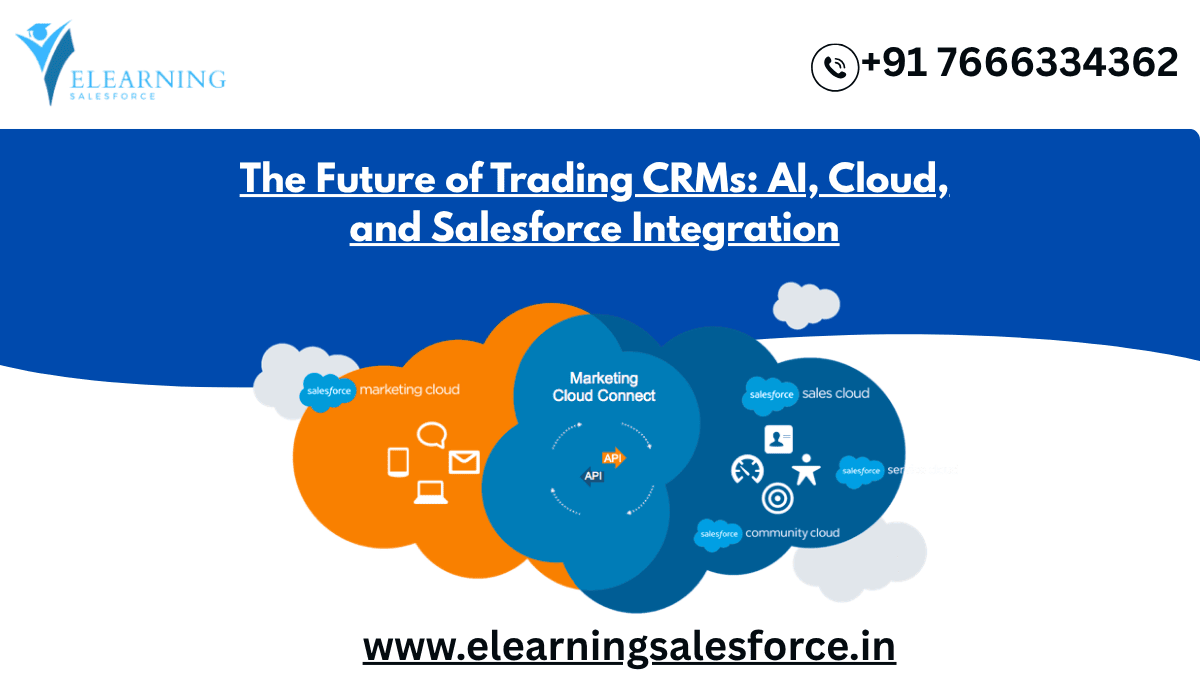
In the fast-paced world of financial trading, data drives every decision. From managing client relationships to tracking trade performance, firms rely on advanced systems to stay ahead of market volatility. Customer Relationship Management (CRM) platforms are now becoming the backbone of trading operations, but not just any CRM—the future belongs to intelligent, cloud-powered, and deeply integrated platforms. Among the top innovations shaping this transformation are AI, cloud technology, and Salesforce integration. These three forces are redefining what trading CRMs can achieve, enabling real-time data visibility, predictive insights, and unmatched scalability.
Why Traditional CRMs Can No Longer Keep Up
Trading desks and financial institutions generate massive volumes of client and market data every second. Legacy CRMs—built for static data management—struggle to keep pace with the demands of modern trading. They often lack real-time synchronization, advanced analytics, and integration with core trading systems like order management or risk platforms. This results in fragmented data, slower response times, and missed opportunities.
The limitations of traditional CRMs are not just technical—they’re strategic. In today’s markets, traders and relationship managers need a system that not only stores data but interprets it instantly. The modern CRM must predict trends, automate processes, and provide actionable insights—all in real time. This is exactly where AI, cloud infrastructure, and Salesforce come together to deliver a revolutionary solution for the trading industry.
The Rise of Cloud-Powered Trading CRMs
Cloud computing has become the foundation for next-generation trading CRMs. By moving from on-premises systems to the cloud, financial institutions gain flexibility, security, and scalability. Cloud infrastructure enables seamless data flow across departments, allowing traders, analysts, and relationship managers to collaborate using the same real-time information.
With platforms like Salesforce Financial Services Cloud, institutions can centralize trade, client, and compliance data in a unified environment. This ensures data consistency while reducing infrastructure costs. Furthermore, cloud-based CRMs provide continuous uptime, remote accessibility, and built-in disaster recovery—critical advantages for global trading operations.
The cloud also paves the way for faster integration with market data feeds, APIs, and external analytics tools. Whether a firm needs to connect Bloomberg terminals, risk engines, or AI-based trading algorithms, a cloud-based CRM like Salesforce offers the agility required to adapt quickly.
Real-Time Trading and Data Synchronization
In trading, even a millisecond delay can mean the difference between profit and loss. Cloud-enabled CRMs support real-time synchronization with trading systems, ensuring that client portfolios, trade statuses, and performance analytics are always up to date. This level of real-time accuracy helps traders respond faster, minimize risks, and offer clients more personalized insights.
Artificial Intelligence: The Brain of Modern Trading CRMs
AI is no longer a futuristic concept—it’s a vital part of how modern trading CRMs function. A Trading CRM with AI and Salesforce Integration can transform raw data into meaningful intelligence. By applying machine learning algorithms and predictive analytics, AI helps institutions detect trading patterns, forecast client behavior, and even predict market shifts.
Salesforce’s Einstein AI is a powerful example. It can analyze historical trade data, client preferences, and market movements to generate predictions or risk alerts. For instance, if a client’s portfolio shows early signs of exposure to volatile assets, Einstein can automatically alert the relationship manager and suggest portfolio adjustments.
AI also enhances automation across trading workflows. Tasks like compliance checks, trade reconciliation, and client onboarding—which traditionally required manual effort—can now be automated using AI-powered CRM workflows. This not only reduces human error but also allows financial professionals to focus on strategy and client engagement.
Predictive Insights for Traders and Relationship Managers
Imagine a trading desk where every relationship manager knows which clients are likely to make their next move. AI-driven CRMs make this possible by analyzing behavioral patterns and generating predictive insights. These insights can be used to recommend suitable investment opportunities, identify cross-selling potential, or anticipate client needs before they arise.
For example, Salesforce Einstein can analyze thousands of data points—client demographics, previous trade history, and external market data—to forecast the next likely trade or portfolio adjustment. This empowers teams to act proactively rather than reactively, turning data into a competitive edge.
Salesforce Integration: The Game Changer for Trading CRMs
Salesforce has long been a leader in CRM innovation, and its ecosystem has expanded well beyond sales and marketing. With its robust APIs and modular architecture, Salesforce now serves as a central hub for trading data management. When integrated with AI and cloud infrastructure, Salesforce creates a seamless environment for both operational efficiency and strategic decision-making.
Through MuleSoft—Salesforce’s integration platform—firms can connect trading platforms, market data providers, and compliance tools directly to their CRM. This creates a single view of all trading and client activities in real time. For instance, when a trade executes in an external platform, MuleSoft can automatically update the client record in Salesforce, trigger a compliance workflow, and send an instant notification to the portfolio manager.
Bridging the Gap Between CRM and Core Trading Systems
In most financial institutions, CRM and trading systems operate in silos. Salesforce integration eliminates this divide by linking CRM functions directly with order management systems (OMS), execution management systems (EMS), and risk engines. This unification provides a complete picture of each client’s trading activity, helping firms identify opportunities, manage risk, and enhance customer experience simultaneously.
Furthermore, integration with Tableau (Salesforce’s analytics platform) allows firms to visualize trade performance and market trends in real time. Executives and analysts can interact with dynamic dashboards that combine CRM data, trading statistics, and compliance reports—all accessible in a single interface.
Security and Compliance in the Cloud Era
In trading, data security and regulatory compliance are paramount. Cloud-based CRMs built on Salesforce ensure both by providing enterprise-grade encryption, secure APIs, and compliance with global standards such as FINRA, MiFID II, and GDPR. Salesforce Shield adds another layer of protection, enabling field-level encryption, audit trails, and real-time monitoring of sensitive financial data.
This makes it possible for firms to adopt advanced technology without compromising on governance. The result is a trusted ecosystem where sensitive trade and client data remain secure—even as they move across systems and geographies.
Industry Trends Driving the Future of Trading CRMs
The evolution of trading CRMs reflects broader industry trends reshaping finance:
1. Personalization through AI
Traders and advisors are leveraging AI to deliver personalized client experiences, tailoring recommendations and portfolio strategies based on predictive data.
2. Cloud-Native Ecosystems
Financial firms are migrating core systems to the cloud, seeking resilience, scalability, and real-time collaboration across borders.
3. Integrated Workflows
The future CRM will not operate as a standalone system but as a dynamic hub connected to trading, compliance, analytics, and communication tools—all powered by Salesforce integration.
4. Real-Time Decisioning
With streaming analytics and AI-driven models, trading CRMs are enabling split-second decision-making that enhances profitability and reduces risk.
Real-World Applications of AI and Salesforce in Trading CRMs
Several leading financial institutions are already adopting AI and Salesforce-powered CRMs to transform operations. For instance, wealth management firms use Salesforce to unify client portfolios, automate risk analysis, and deliver personalized investment advice. Hedge funds and brokerages leverage AI-driven insights from Salesforce to anticipate market shifts and rebalance portfolios accordingly.
One global investment firm integrated Salesforce Financial Services Cloud with MuleSoft and Tableau to achieve a 360-degree view of trading activities across regions. This integration reduced reporting times by 60% and improved client engagement metrics significantly.
The Road Ahead: Intelligent Trading CRM Ecosystems
The next generation of Trading CRMs with AI and Salesforce Integration will go beyond automation and data centralization. They will become intelligent ecosystems that predict, adapt, and evolve in real time. Salesforce’s upcoming features—like Einstein Copilot and AI-driven trade modeling—promise to make data insights even more intuitive and actionable.
We are entering an era where CRMs will not just manage relationships but will become strategic partners in trading decisions. By blending AI intelligence, cloud scalability, and Salesforce’s integration power, financial institutions can turn their CRMs into engines of growth and innovation.
Empowering Financial Teams for the Future
The transformation of trading CRMs is not just about technology—it’s about empowering people. With the right CRM strategy, trading firms can enable advisors, analysts, and executives to work from the same data-driven foundation. This leads to better decisions, stronger client relationships, and faster market responses.
The combination of AI, cloud, and Salesforce is setting a new benchmark for performance, transparency, and client-centricity in the trading world. The future belongs to firms that embrace these technologies early and build intelligent, connected ecosystems around them.
Take the Next Step in Building Your Intelligent Trading CRM
If your firm is ready to transform how it manages clients, trades, and data, now is the time to explore a Trading CRM with AI and Salesforce Integration. Start by evaluating your existing CRM setup, identifying data silos, and considering how Salesforce Financial Services Cloud and MuleSoft can unify your systems. Visit our website to explore expert resources, implementation guides, and advanced training programs that can help you design a future-ready trading CRM for your organization.
you may be interested in this blog here
Integration with SAP Systems and Workflows
9000+ salesforce developer jobs in usa (56 new)


