
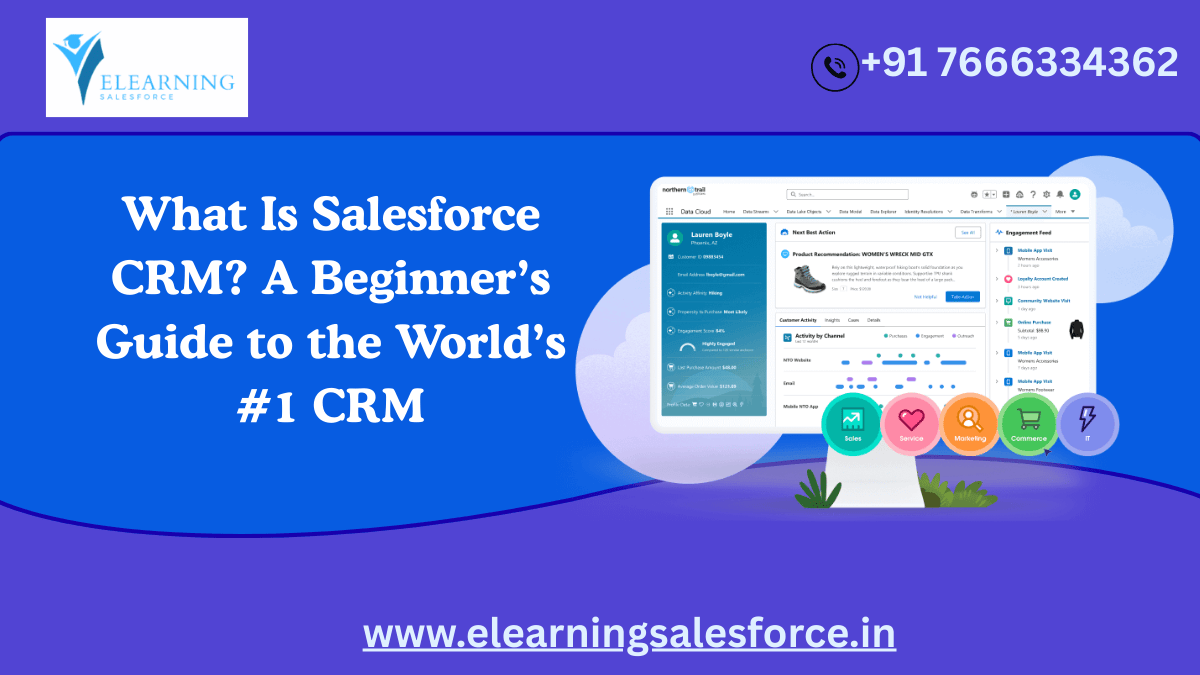
In today’s digital-first business world, customers expect faster responses, personalized experiences, and seamless communication. Managing all of this manually or through disconnected tools is nearly impossible. That’s where Salesforce comes in.
If you’ve ever wondered what is Salesforce CRM and why companies across the globe rely on it, this beginner’s guide will walk you through everything you need to know—step by step, in simple language.
Whether you’re a student exploring career options, a professional working in sales or marketing, or a company employee trying to understand your organization’s tools, this guide is designed for you.
What Is Salesforce CRM?
Salesforce is a cloud-based Customer Relationship Management (CRM) platform that helps businesses manage customer data, sales processes, marketing campaigns, customer service, and analytics—all in one place.
In simple terms, Salesforce CRM helps companies:
- Track customer interactions
- Manage leads and sales pipelines
- Automate repetitive tasks
- Improve customer support
- Make data-driven decisions
Because it is cloud-based, Salesforce can be accessed anytime, anywhere, using a browser or mobile app—no complex installations required.
Why Is Salesforce Called the World’s #1 CRM?
Salesforce consistently ranks as the #1 CRM platform worldwide, and this reputation is not accidental.
Here’s why Salesforce dominates the CRM market:
- Trusted by startups, enterprises, and global brands
- Highly scalable for small to large businesses
- Powerful customization without heavy coding
- Strong ecosystem of apps and integrations
- Continuous innovation with AI and automation
Companies like Amazon, Google, Netflix, Toyota, and thousands of others use Salesforce CRM to manage customer relationships efficiently.
How Does Salesforce CRM Work?
At its core, Salesforce works as a central hub for customer information.
Imagine a single platform where you can see:
- Customer contact details
- Emails and call history
- Purchase records
- Support tickets
- Marketing engagement
Instead of scattered spreadsheets and tools, Salesforce CRM stores everything in one connected system.
For example:
A sales representative can see which marketing emails a customer opened, while a support agent can view past purchases before resolving an issue. This shared visibility improves collaboration and customer experience.
Key Components of Salesforce CRM
Salesforce is not a single tool—it’s a platform made up of multiple “clouds,” each designed for specific business functions.
Sales Cloud
Sales Cloud helps sales teams manage:
- Leads and opportunities
- Sales pipelines
- Forecasting and reporting
- Task automation
Example: A sales executive can track which deals are likely to close this month and prioritize high-value prospects.
Service Cloud
Service Cloud focuses on customer support and service teams by enabling:
- Case management
- Live chat and chatbots
- Omni-channel support (email, phone, social)
- Knowledge bases
Example: A support agent can resolve customer issues faster by viewing previous cases and interactions.
Marketing Cloud
Marketing Cloud helps businesses create personalized marketing campaigns using:
- Email marketing
- Customer journeys
- Social media engagement
- Data-driven personalization
Example: A company can send customized offers based on customer behavior and preferences.
Experience Cloud
Experience Cloud allows businesses to create:
- Customer portals
- Partner portals
- Community forums
Example: Customers can log in to check order status or raise service requests without calling support.
Salesforce Platform and AppExchange
Salesforce also provides:
- Custom app development tools
- Low-code and no-code options
- AppExchange marketplace with thousands of ready-made apps
This flexibility is a major reason Salesforce CRM fits almost every industry.
What Makes Salesforce Different from Other CRMs?
Many CRMs exist, but Salesforce stands out due to several unique advantages.
First, Salesforce is 100% cloud-based, meaning no local servers or heavy IT maintenance.
Second, it is highly customizable, allowing companies to tailor workflows, dashboards, and automation to match their exact processes.
Third, Salesforce integrates Artificial Intelligence through Einstein AI, which provides insights, predictions, and automation suggestions.
Finally, Salesforce has a massive global community, extensive learning resources, and strong job market demand.
Salesforce CRM for Beginners: Real-World Use Cases
Understanding what is Salesforce CRM becomes easier when you see it in action.
Sales Team Use Case
A sales manager uses Salesforce to track team performance, monitor deal progress, and forecast revenue accurately.
Marketing Team Use Case
A marketer runs automated campaigns that send follow-up emails when a customer clicks a product link.
Customer Support Use Case
A service agent resolves issues faster by viewing the customer’s entire history on a single screen.
Management Use Case
Executives use dashboards and reports to analyze business performance in real time.
Salesforce CRM and Current Industry Trends
Salesforce continues to evolve with modern business trends.
Artificial Intelligence and Automation
Salesforce Einstein AI helps predict customer behavior, recommend next actions, and automate tasks.
Data-Driven Decision Making
Advanced analytics enable companies to make smarter decisions based on real-time data.
Remote and Hybrid Work
Cloud accessibility allows teams to work efficiently from anywhere.
Industry-Specific Solutions
Salesforce now offers industry clouds for healthcare, finance, retail, and manufacturing.
Is Salesforce Easy to Learn for Beginners?
Yes, Salesforce is beginner-friendly—especially with the right learning approach.
Salesforce offers:
- Trailhead (free learning platform)
- Hands-on practice environments
- Certifications for career growth
Even non-technical users can learn Salesforce basics and become productive quickly.
Career Opportunities with Salesforce CRM
Learning Salesforce CRM opens doors to high-demand roles such as:
- Salesforce Administrator
- Salesforce Developer
- Salesforce Consultant
- Business Analyst
With growing global adoption, Salesforce skills remain valuable and future-proof.
Who Should Learn Salesforce CRM?
Salesforce is ideal for:
- Students and fresh graduates
- Sales, marketing, and support professionals
- IT professionals looking to upskill
- Business owners and managers
Understanding what is Salesforce CRM is no longer optional—it’s a competitive advantage.
Final Thoughts: Why Salesforce CRM Matters Today
Salesforce CRM is more than just software—it’s a complete ecosystem that helps businesses build stronger customer relationships, streamline operations, and grow smarter.
For beginners, Salesforce offers an easy entry point into the world of CRM, cloud computing, and digital transformation. For companies, it provides the tools needed to stay competitive in a customer-driven economy.
Call to Action
Ready to go beyond just understanding what is Salesforce CRM?
Explore beginner guides, hands-on courses, and certification paths to start your Salesforce journey today. Whether you want to grow your career or improve your organization’s processes, Salesforce skills can open powerful opportunities.
you may be interested in this blog here
Charting a Course to ROI: Navigating Intent Data Challenges Effectively
