
In the high-stakes world of financial trading, milliseconds matter. From equities to commodities, trade data floods in at lightning speed, and firms need to process, analyze, and act on it in real time. For years, legacy trading systems have been built to handle such massive transactional volumes, but as the industry evolves, companies are increasingly looking toward modern cloud platforms like Salesforce for scalability, agility, and data intelligence. The question that often arises is can Salesforce truly handle high-volume trade data in real time? The answer lies in how the platform combines its robust data architecture, scalable cloud infrastructure, and AI-driven analytics to create a seamless environment for real-time financial operations.
The Modern Challenge of Managing Trade Data
Today’s financial markets generate billions of data points every day from trades, orders, and quotes to client interactions and compliance reports. Brokerage firms, asset managers, and fintech platforms face an ongoing struggle: how to process all this data without sacrificing speed or accuracy. Traditional databases and monolithic systems often hit performance bottlenecks when data volumes surge during peak trading hours. As digital transformation reshapes the financial landscape, organizations need a platform that can unify their trade data, automate reporting, and deliver instant insights—all in real time.
This is where Salesforce enters the picture. Originally designed as a CRM, Salesforce has evolved into a comprehensive cloud ecosystem capable of supporting mission-critical financial operations. With its multi-cloud structure spanning Financial Services Cloud, Tableau, MuleSoft, and Einstein AI Salesforce can now handle complex data environments that were once limited to on-premises trading systems.
How Salesforce Handles High-Volume Trade Data
The capability of Salesforce real-time trade data management stems from three technological pillars: scalability, integration, and intelligence.
1. Cloud Scalability for Continuous Data Streams
At its core, Salesforce is built on a multi-tenant cloud architecture that scales dynamically with demand. This allows financial institutions to ingest and process large volumes of trade data without needing to expand physical infrastructure. Salesforce’s Lightning Platform and Hyperforce (its public cloud infrastructure upgrade) are key to achieving this scalability.
With Hyperforce, Salesforce enables regional data storage and processing at hyperscale speeds. This means trade data from markets across the world can be synchronized and analyzed locally while still feeding into a unified global dashboard. The system’s elastic scalability ensures that even during trading spikes—such as earnings seasons or market volatility—Salesforce maintains consistent performance without downtime.
2. Real-Time Data Integration with MuleSoft
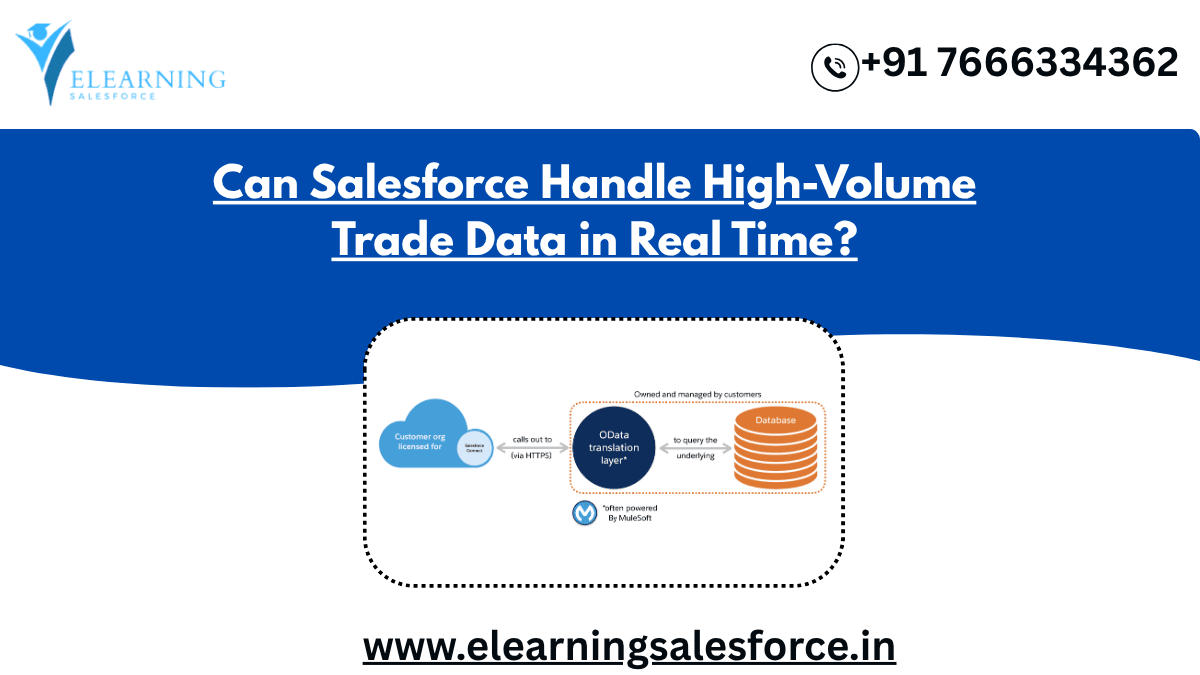
Handling high-volume trade data isn’t just about storing it it’s about integrating it efficiently from multiple systems. In financial firms, trade data often comes from diverse sources like Bloomberg, Refinitiv, FIX protocols, and internal order management systems (OMS). MuleSoft, Salesforce’s integration platform, acts as the connective tissue that unites all these sources into one cohesive ecosystem.
MuleSoft APIs allow seamless real-time data exchange between Salesforce and trading systems. For example, when a trade executes, MuleSoft can instantly push that information into Salesforce CRM, where it updates client portfolios, compliance dashboards, and risk metrics. This synchronization enables advisors, traders, and compliance officers to work from a single source of truth ensuring faster decisions and fewer manual errors.
3. High-Performance Analytics with Tableau and Einstein AI
Processing trade data in real time is only valuable if it leads to actionable insights. Salesforce combines Tableau’s advanced analytics with Einstein AI to transform trade data into predictive intelligence. Tableau visualizes streaming data in dashboards that update live, giving financial professionals a clear view of market performance, client activity, and exposure.
Einstein AI then applies machine learning models to identify trends such as unusual trade patterns, client behaviors, or potential risks. This helps institutions detect fraud, optimize trading strategies, and deliver personalized investment recommendations in real time. The combination of analytics and AI ensures that Salesforce doesn’t just handle large data volumes it transforms them into strategic advantage.
Architecting Real-Time Performance: How It Works
Salesforce’s ability to manage trade data at scale is powered by its event-driven architecture. The Salesforce Platform Events framework enables real-time communication between applications. When a trade event occurs, the system instantly triggers corresponding workflows, notifications, or analytics updates without lag.
For instance, if a brokerage platform executes 50,000 trades per second, each trade can generate event messages that flow through Salesforce’s Event Bus. These messages update CRM records, trigger risk alerts, and even feed into dashboards without manual intervention. Combined with asynchronous processing and data caching, Salesforce ensures speed and reliability even under massive data loads.
To further enhance real-time capability, Salesforce integrates with Kafka-based data pipelines, allowing continuous data streaming and processing. This makes it suitable for institutions that rely on sub-second latency in trade analysis and reporting.
Practical Applications in Financial Institutions
Several financial organizations are already leveraging Salesforce to manage and interpret trade data in real time.
Brokerage and Wealth Management
Brokerage firms use Salesforce Financial Services Cloud to unify trade data, client information, and compliance records. This provides advisors with a 360-degree view of client portfolios updated instantly after every trade. When integrated with Tableau, the platform also offers performance insights, portfolio diversification tracking, and regulatory reporting automation.
Investment Banking
Investment banks use Salesforce to centralize deal pipelines, market positions, and client communications. With MuleSoft handling integrations, traders can access real-time trade status, pricing feeds, and execution analytics within the Salesforce interface. This eliminates silos and speeds up both client servicing and decision-making.
Asset Management and Hedge Funds
For asset managers, Salesforce provides a single platform for monitoring trades, fund flows, and investor interactions. Einstein AI models forecast portfolio risks and opportunities, while Tableau visualizes live fund performance. By integrating Salesforce with existing trading and risk systems, firms gain an end-to-end digital ecosystem for data-driven portfolio management.
Overcoming Common Myths About Salesforce in Trading Environments
One common misconception is that Salesforce, being a CRM, cannot handle the data velocity and volume of financial trading. In reality, its modular architecture and API-driven integrations make it highly adaptable to trading environments. Another myth is around latency many assume cloud-based systems are slower than on-premises setups. However, Salesforce’s Hyperforce deployment, combined with modern data caching and edge computing, minimizes latency to near real-time levels.
Moreover, with Salesforce Shield and encryption-at-rest features, firms can maintain compliance with stringent financial regulations like MiFID II, SEC, and FINRA, ensuring data security while maintaining agility.
The Future of Real-Time Trading Data in Salesforce
The evolution of Salesforce real-time trade data processing is just beginning. As financial services increasingly adopt digital-first strategies, Salesforce is enhancing its ecosystem with more advanced capabilities such as generative AI for market forecasting, blockchain integrations for transaction transparency, and expanded support for high-frequency trading analytics.
Future versions of Salesforce Einstein are expected to integrate predictive trade simulation and anomaly detection models helping firms anticipate market fluctuations and optimize trading decisions. Combined with emerging data technologies like Snowflake integration and data lakes on Salesforce Data Cloud, the platform is poised to become a central hub for real-time financial intelligence.
Why Salesforce Is the Right Fit for Modern Financial Firms
Salesforce’s strength lies in its ability to unify complex financial systems under one intelligent framework. For firms dealing with high-volume trade data, it provides:
- Real-time scalability for data-intensive operations
- Seamless integration with trading and compliance systems
- Predictive analytics and AI for smarter decisions
- Strong compliance and security measures
- A modular, cloud-native environment built for innovation
In an era where speed, transparency, and personalization define financial success, Salesforce empowers institutions to move faster and smarter—turning trade data into competitive advantage.
Take the Next Step Toward Real-Time Financial Intelligence
If your organization is exploring solutions to manage high-volume trade data, Salesforce offers a future-proof platform that balances performance, compliance, and innovation. Start by assessing your existing data landscape and exploring how Salesforce Financial Services Cloud, MuleSoft, and Tableau can modernize your trade operations. Visit our website to access expert guides, advanced learning materials, and practical implementation strategies that can help your business harness the full potential of Salesforce for real-time financial data management.
you may be interested in this blog here:-

